Claude Opus 5.5 vs. Fable 5.1: What Changed, and Which Should You Use?
Opus 5.5 makes a strong case for a trial as your everyday coding model. Keep Fable 5.1 where better results on your own work justify its higher API rates.
In this story
Documentation checked September 23, 2026. This is a source-based comparison, not a hands-on benchmark. The evaluation workflow below is proposed; we have not run these two models against it.
If you already use Fable 5.1, the useful question is whether Opus 5.5 can finish the same work with less spending and less supervision. Try it on a task you understand well enough to judge. Keep Fable available for the cases where it earns its place.
Anthropic released Opus 5.5 on September 22. Its launch results make it worth testing, but they do not establish how either model will behave in your repository. Our recommendation is to trial Opus first for repeatable implementation and review work, then choose by accepted results rather than model tier. Opus 5.5 announcement
The differences at a glance
These are documented specifications and standard Claude API prices, not measured task costs. USD rates are per million tokens; fast mode and other pricing modifiers are separate.
| Decision point | Claude Opus 5.5 | Claude Fable 5.1 |
|---|---|---|
| Claude API model ID | claude-opus-5-5 | claude-fable-5-1 |
| Standard input | $4 | $10 |
| Output | $20 | $50 |
| Cache read | $0.20 | $0.25 |
| Five-minute cache write | $5 | $12.50 |
| Context window | 1 million tokens | 1 million tokens |
| Ordinary maximum output | 128,000 tokens | 128,000 tokens |
| Documented API default effort | medium | high |
| Thinking | Adaptive, always on | Adaptive, always on |
Sources: Opus specifications, Fable specifications, API pricing.
Context capacity alone gives you no reason to pay more for Fable: the published limits match. Both accept text and image input and produce text. Opus also has a separately priced fast mode; its ordinary 128,000-token output limit should not be confused with the 300,000-token Batch API beta. Opus capabilities
Fable remains positioned for demanding reasoning and long projects. That describes its intended use, not an exclusive capability: Opus 5.5 also targets extended coding and knowledge work. A multi-file task is a reason to evaluate both, not an automatic reason to select Fable. Fable overview
The price gap depends on what you consume
At equal usage, Opus costs 60% less for standard input and output, but only 20% less for cache reads. A session dominated by repeated cached context has a different price mix from one generating a large patch.
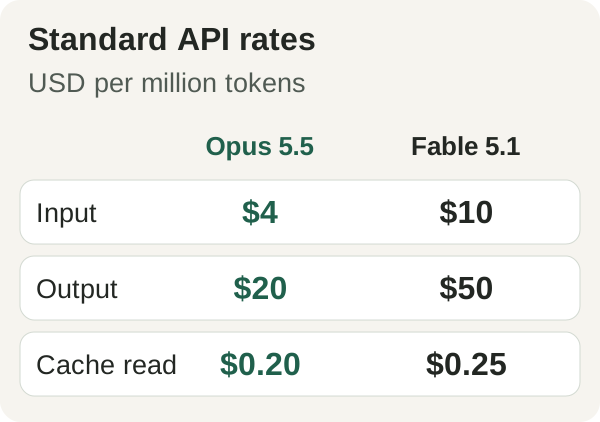
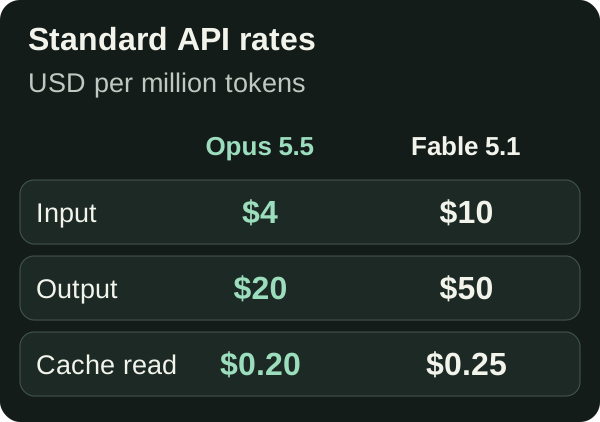
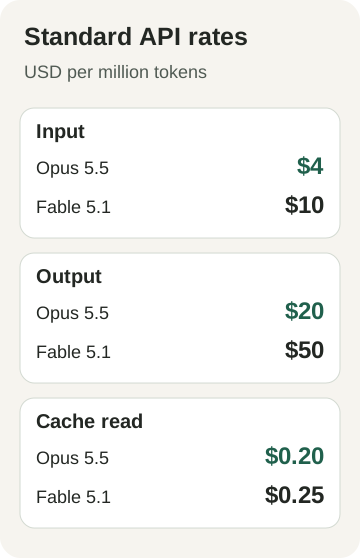
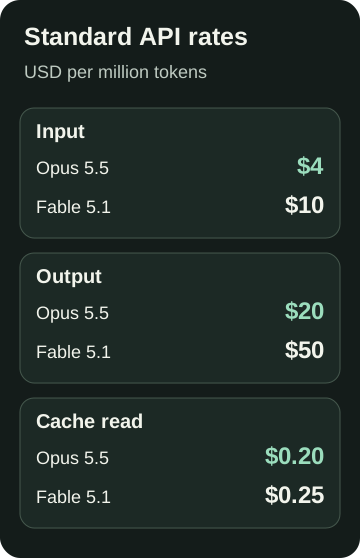
For a deliberately simple illustration, 100,000 uncached input tokens and 20,000 output tokens cost $0.80 on Opus and $2.00 on Fable. This arithmetic excludes cache operations, tools and pricing modifiers; it is not an observed coding session. Actual runs can consume different amounts.
Anthropic's estimated 40% workload saving compares Opus 5.5 with Opus 5, not Fable. Do not carry that percentage into this comparison. Launch cost comparison
The standard rates also stop being the right comparison when you enable fast mode. Opus 5.5 fast mode lists $8 input and $40 output per million tokens. Measure its benefit against the extra charge. Fast-mode pricing
For a Claude subscription, a lower API token rate does not mean a proportional reduction in your monthly bill or a guaranteed number of extra tasks. Pro and Max usage is shared across Claude and Claude Code. An ANTHROPIC_API_KEY in your environment can cause Claude Code to use API billing instead. Check which account and billing mode the session uses before interpreting a rate chart as a subscription promise. Claude Code plans and billing
What the launch benchmarks actually tell you
Anthropic reports CursorBench 4.0 scores of 52.5% for Opus 5.5 at medium effort and 51.8% for Fable 5.1 at max. Its headline table instead gives Opus 57.8% at max. Those are different configurations, not contradictory scores. Its evaluations also include production safeguards and, on some tasks, fallback models. The release cautions that its experience of the gap is smaller than benchmark margins suggest. These are vendor-reported results, not our measurements. Benchmark results and settings
That is enough to justify a trial of Opus at a modest effort setting. It is not enough to promise that it will need fewer corrections on your particular work. A benchmark cannot tell you whether a model overlooked the undocumented rule your billing service depends on.
Keep Fable where repeated tests show a useful advantage: finding a root cause Opus misses, preserving requirements across a difficult change, or producing a patch that takes less time to review. These are selection criteria, not claims that Fable wins those categories. If your existing Fable workflow reliably handles a costly failure mode, replace it only after the alternative clears that same check.
Access and integration still matter
Both models are listed for Pro, Max, Team and Enterprise subscribers, and across Anthropic's API and major cloud platforms. Availability still depends on your account and deployment. AgentGrid organizes the working sessions; it does not supply a Claude subscription or API allowance. Opus access, Fable access
There is a material distinction for organizations with zero-data-retention requirements. Anthropic says Opus 5.5 is available with zero data retention. Fable has a default 30-day safety-retention requirement, with an exception for eligible organizations notified that they can use it with zero retention. Confirm the terms that apply to your deployment; neither statement means a normal consumer chat is automatically unretained. Opus retention, Covered-model retention and eligibility
If you maintain your own API client, changing the model name deserves an integration check. Opus 5.5 rejects disabled or manually budgeted thinking and forced tool calls. It also changes how progress text between tool calls is returned. Some of these behaviors already exist in Fable 5.1, so they are not all new differences between the two. Check the official migration guide against your current request and response handling. Opus migration guide
Compare one real task in AgentGrid
Use a task with a result you can verify: a known regression, a small feature with acceptance tests, or a review against a fixed set of requirements. For a first exercise, consider a filter that must match a title or owner without changing the original ordering. Decide how empty input, case and surrounding whitespace should behave before either model begins.
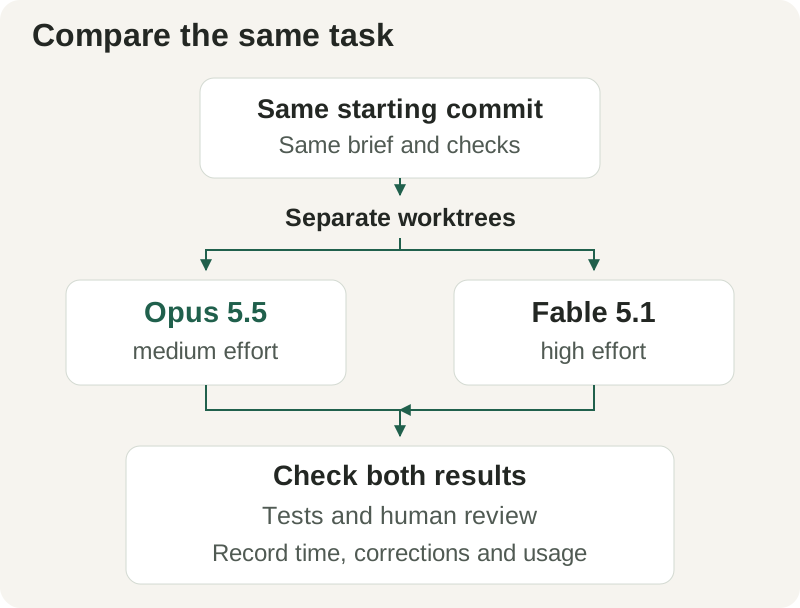
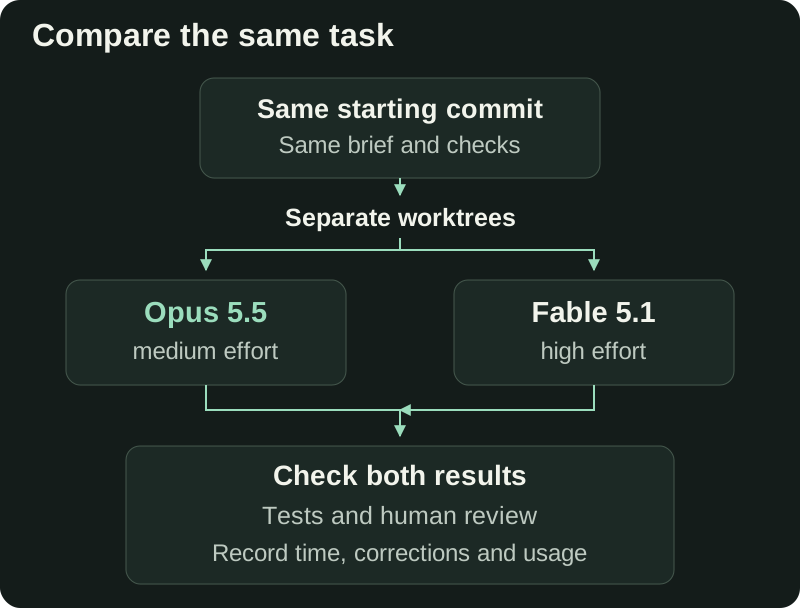
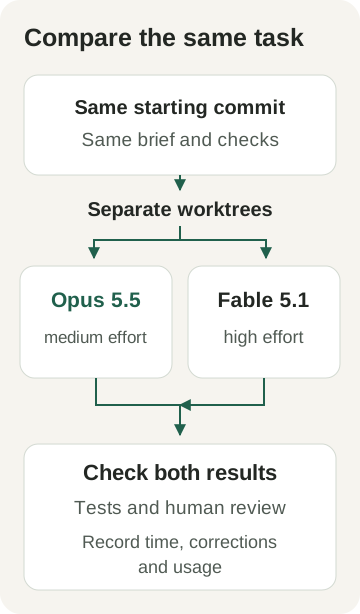
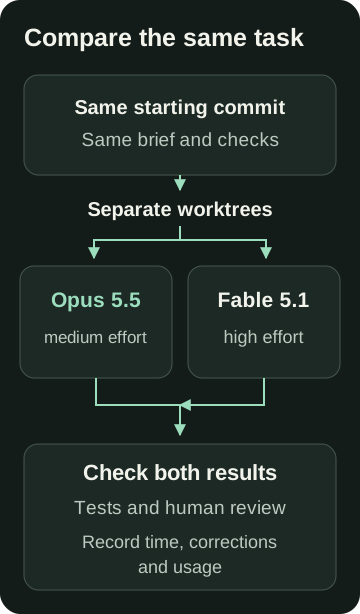
Keep both runs visible in AgentGrid, with the brief in a note and the checks in terminals. Its existing builder-and-reviewer guide explains the separate-worker handoff. Here, adapt that arrangement to compare two implementations of the same task.
Start from the same code
Ask your lead agent to create two dedicated worktrees from the same recorded commit using AgentGrid's worktree tool. Give each run its own working directory. Copy the same brief and checks into both; do not let one run see the other's solution before it finishes. AgentGrid supports model selection and visible workers through its orchestration tools.
Check the current model catalog before asking a lead to launch a pinned worker. For a direct CLI setup, open a terminal pane in each worktree and start a fresh Claude Code session there. These are alternative commands for two separate terminals:
claude --model claude-opus-5-5 --effort mediumclaude --model claude-fable-5-1 --effort highOpus 5.5 requires Claude Code 2.1.280 or later. Check claude --version and update with claude update if needed. Confirm the active model and effort in the session before starting; account policy and configuration can affect what is available. Claude Code model configuration
The commands use each model's documented default effort. That is a practical starting comparison, not a claim of equal reasoning budgets. Anthropic explicitly says effort labels are calibrated per model. A second pass can compare settings within the same spending or time limit. Also record any safeguard-triggered model fallback; a run completed by another model is a different result. Effort and fallback configuration
Give both runs the same brief
Adapt this proposed prompt to your repository, then send the identical version to each session:
Implement the task described below in this assigned worktree only.

Task:
[State the requested behavior and acceptance criteria.]

Checks:
[List the existing check commands and the edge cases to add.]

Inspect the relevant code before editing. Preserve behavior outside the
task. Run the checks and report their actual results, including failures
or anything you could not run. Do not change an acceptance criterion to
make a check pass.

Finish with changed files, remaining risks and any decision that needs
human review. Do not merge or deploy. Stop after the handoff.
This prompt is a starting point, not a reported experiment. Keep the same tool permissions, dependencies and instructions for both runs. Save each diff and test output before asking for revisions.
Judge the handoff, then record the cost
Run the same checks independently. Inspect whether the implementation actually satisfies the brief and whether its tests would catch the original failure. Record model, effort, elapsed time, failed checks, follow-up prompts and your review time. For API billing, record actual input, output, cache usage and charges; for subscriptions, record the allowance information available to you instead of inventing a dollar cost.
A fast patch that needs three rounds of correction can be the more expensive result. Conversely, a longer first run may save review work. Repeat across several representative tasks before changing a team default, and keep results separated by task type. One filter exercise cannot decide which model should own a large migration.
Which should you use?
Trial Opus 5.5 first if your recurring tasks have clear acceptance checks and you want to test a lower-cost API option. Promote it where the results hold up after review.
Retain Fable 5.1 where you have evidence that its output is worth the extra spend or where switching would disrupt a well-understood workflow before the replacement has been evaluated. A mixed choice is reasonable: keep the model that works for each class of task.
Download AgentGrid to keep the two sessions, their instructions and the test output together while you make that decision. Start with one real task and a check you trust; expand the experiment when the first comparison teaches you something useful.