Stop Being the Clipboard Between Your Coding Agents
A useful agent team needs clear ownership and a checkable handoff. Start with those before adding more workers.
 AgentGrid
Conceptual motion, 33 seconds. Not a recorded review and not a measured speedup.
Read the transcriptIn this story
Prepared by AgentGrid with AI assistance. The exercise below is proposed, not a completed benchmark. Product documentation checked October 6, 2026.
You ask one agent to build a feature. It finishes with a confident summary. You copy that summary into a second agent, explain the original request again, collect its findings, and carry those back to the first. A few rounds later, you are coordinating messages instead of deciding whether the feature is ready.
That is the problem this article addresses. The goal is to make the handoff precise enough that the next agent can start checking the work without making you reconstruct it.
Give the next agent something it can inspect
A completion message is an assertion. A revision, a diff and a test result give the reviewer something to investigate.
Consider a proposed change to a form: whitespace-only names should be rejected. A builder reports that validation works. The useful questions are narrower. Which input path changed? Was the browser checked, or only a helper function? Does the server enforce the same rule? Did a later edit invalidate the reported result?
Use a handoff like this:
Goal: reject whitespace-only names without changing valid submissions.
Owner: builder; reviewer checks and reports findings.
Scope: name validation and its existing submission path.
Revision: [actual commit or clearly identified uncommitted diff]
Evidence: [actual commands, results and capture paths]
Unverified: [checks not run and assumptions still open]
Next action: review this revision against the stated behavior.
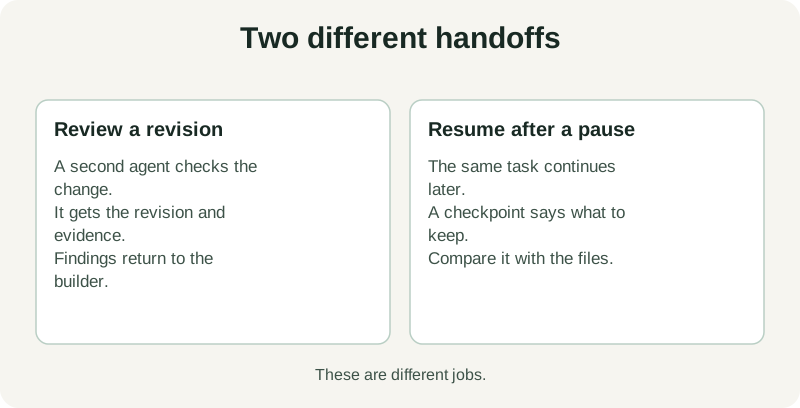
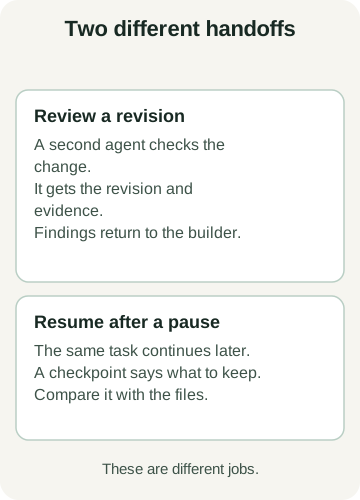
The bracketed fields are deliberately unfinished. Fill them from the run. A realistic-looking test count is worse than an empty field because it invites the next person to trust evidence that does not exist. This handoff equips a second agent to review a revision; a checkpoint for resuming the same task after a pause serves a different purpose.
Separate ownership from visibility
Seeing the same files does not mean two agents should edit them at once. Give one agent responsibility for implementation and another a clear review scope. Asking a reviewer not to edit is an instruction, not a filesystem boundary. When a finding needs a fix, route it to the builder rather than letting both agents independently repair the same lines.
Decide what happens when they disagree. A useful rule is to return to the requested behavior and a reproducible case. Neither the builder's confidence nor the reviewer's title settles the question.
For the form example, a reviewer might find that browser validation rejects spaces while a direct server request accepts them. That would be a concrete test to resolve. This is an illustrative finding, not a result from a run we performed.
Anthropic's native agent-team documentation describes coordinated sessions with their own contexts and shared coordination mechanisms. AgentGrid has its own orchestration tools and can coordinate workers across installed harnesses. Those are different systems; a capability documented for one should not be assumed to exist in the other. Claude Code agent teams, AgentGrid orchestration
Parallelize the parts that do not need each other yet
A separate investigation can be useful while implementation proceeds: one worker studies an API contract while another checks the current tests. Two workers rewriting the same form from different assumptions need more coordination.
Before splitting a task, ask what each worker can finish without waiting for another worker's unfinished decision. If the answer is nothing, a short sequence may be easier to manage than parallel work.
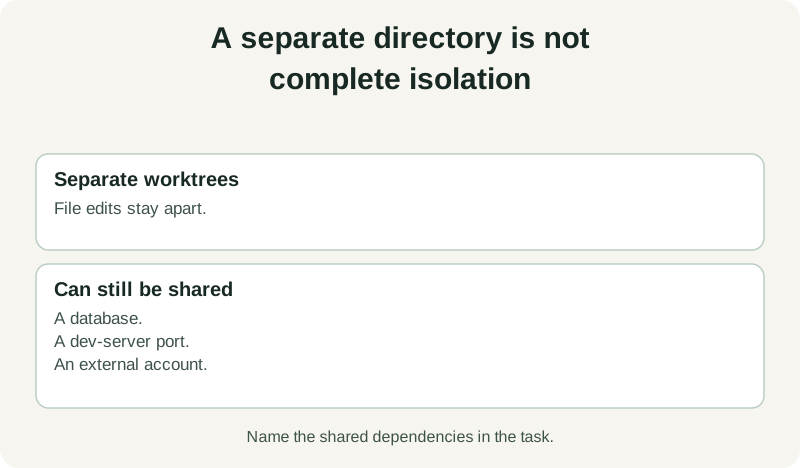
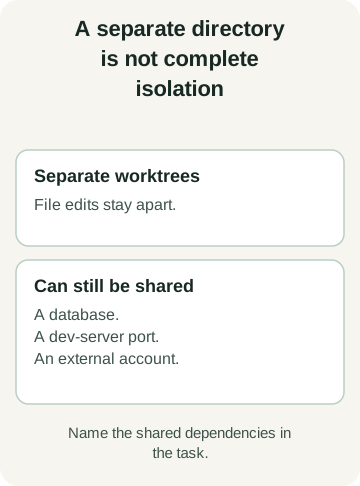
Isolation also needs a concrete meaning. Separate worktrees keep file changes apart, but a shared database, dev-server port or external account can still connect two experiments. Name those dependencies in the task instead of treating a separate directory as complete isolation.
Keep the review loop attached to the actual revision
The useful sequence is simple: implementation, evidence, review, correction, verification. A review of yesterday's code does not approve today's change.
In AgentGrid, a master can inspect worker progress, wait for completion and send a follow-up to the same worker. Reusing the builder returns the correction to the worker that did the implementation; it does not guarantee that every earlier detail remains in the model's context. Keep the important constraints and evidence in the handoff. The existing build-and-review Workflow provides a starting prompt, while the orchestration Guide explains the controls.
Keep the final decision explicit. A second model can find things the first missed, but it can also miss the same defect or introduce an incorrect objection. The task still needs observable acceptance criteria and an owner who checks the evidence.
Try one small handoff
Choose a bounded change with an outcome you can verify. Record how often you had to restate context, how many review findings were actionable, and which checks caught real problems. Include the time you spent explaining and reconciling work.
Those observations will tell you more than the number of agents you managed to start. If a second worker creates more clarification than useful checking, simplify the task split before expanding the team.
Download AgentGrid to keep the builder, reviewer and their outputs in one workspace. Start with one clear handoff, then decide whether the next task benefits from another agent.